No. Bitcoin is pseudonymous, not anonymous. Every transaction is recorded on a permanent public ledger anyone can read, and specialist chain-analysis firms trace it routinely. Once any address links to a regulated exchange that knows its customers, the pseudonym gains a real name. This is how many dark web cases are solved. Monero is the true privacy coin, hiding sender, receiver and amount.
- Bitcoin is pseudonymous, not anonymous
- Every transaction is permanent and public on the blockchain
- Chain analysis is an industry that turns addresses into names
- One link to a regulated exchange unravels the chain
- Monero is the actual privacy coin — and gets delisted for it
The belief that Bitcoin is anonymous is the most expensive misconception in the history of the dark web. It's pseudonymous, not anonymous — every transaction is permanently public — and that misunderstanding has sent many people to prison.
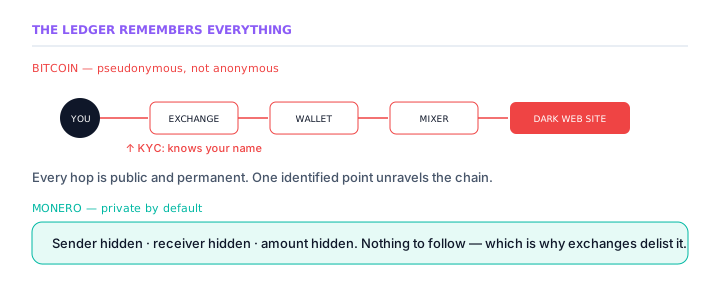
The public ledger
Bitcoin works by writing every transaction ever made to a shared public ledger — the blockchain — that anyone can download and inspect forever. Addresses aren't names, which looks like anonymity, but “no name attached” is not the same as “untraceable.” The permanent, public record is close to the worst possible property for someone trying to hide.
Following the money
An entire industry — chain analysis — turns the public ledger into names. The technique is patient: addresses that spend together are probably one person, and flows can be followed across thousands of hops. Crucially, the chain almost always touches a regulated exchange, which by law knows its customers. The moment any address links to that account, the pseudonym gains a name.
What about mixers?
Mixers (or tumblers) pool many people's coins and redistribute them to break the trail. They add friction but don't defeat tracing: patterns survive, some mixers are scams or law-enforcement operations, and simply using a known mixer has become a flag. Several major mixers have been seized or sanctioned.
Monero: the actual privacy coin
The cryptocurrency genuinely associated with privacy is Monero. It hides the sender (ring signatures), the receiver (stealth addresses), and the amount (RingCT) by default. There's no transparent trail to follow — which is exactly why many regulated exchanges delist it and some jurisdictions restrict it. Bitcoin is watched because it can be followed; Monero because it cannot.
Frequently asked questions
Is Bitcoin anonymous?
No. Bitcoin is pseudonymous, not anonymous. Every transaction is on a permanent public ledger that anyone can read, and chain-analysis firms trace it routinely. Once an address links to a regulated exchange, the pseudonym gains a real name.
Can Bitcoin transactions be traced?
Yes, routinely. The blockchain is a permanent public record, and following the money is a standard investigative technique. Many dark web prosecutions began not by breaking Tor but by tracing payments to an exchange that knew the customer.
Do mixers make Bitcoin anonymous?
No. Mixers add friction to tracing but don't defeat it. Chain analysis firms routinely de-anonymize transactions that pass through mixers by using techniques such as taint analysis, amount correlation, timing analysis, and graph clustering. Even when a mixer works exactly as advertised, the output coins inherit a history that can often be linked back to the input address. Some mixers have been operated by law enforcement or exit-scammed, taking users' funds while providing no privacy at all. Using a known mixer address is itself a strong heuristic: regulated exchanges flag deposits from mixing services and may freeze or report them. Major enforcement actions have included the seizure of servers, the arrest of operators, and sanctions against mixing protocols—demonstrating that mixers are a weak layer, not a solution.
Is Monero more anonymous than Bitcoin?
Categorically. Monero hides the sender, receiver and amount by default, so there's no public trail to follow. This is why exchanges delist it and regulators watch it, while Bitcoin is watched precisely because it can be traced.
Why do criminals get caught through Bitcoin?
Because Bitcoin keeps a permanent public record of every payment. Unlike the Tor network, the money traces itself, and chain analysis only needs one link to a regulated exchange — which knows its customers — to attach a real identity.