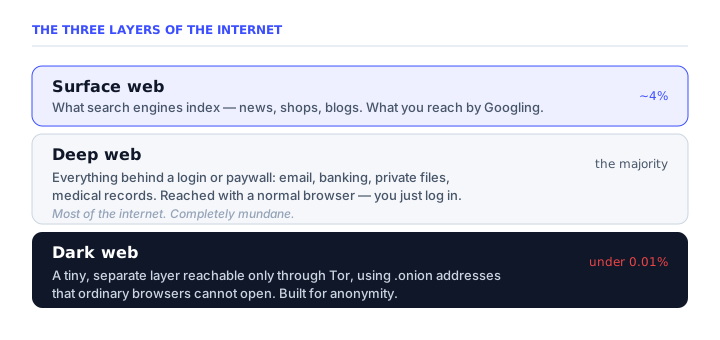
The surface web is everything a search engine can find and any browser can open without logging in — news, shops, public pages, the everyday internet. The dark web is the opposite: a tiny set of sites you can't find on a search engine and can't open without Tor, using .onion addresses designed to be hidden and anonymous. Between them is the deep web — the huge, mundane layer behind logins.
- Surface web: open, searchable, everyday — the visible internet
- Dark web: hidden, Tor-only, anonymous, under 0.01%
- Surface is built to be found; dark is built to hide
- The deep web is the huge middle, behind logins
- The iceberg image wrongly equates “hidden” with “sinister”
The internet is often described in three layers — surface, deep, and dark. Most explanations muddle them. This one focuses on the two people most often contrast: the surface web you use every day, and the dark web you need special software to reach.
The surface web
The surface web is everything a search engine can find and an ordinary browser can open without logging in: news sites, blogs, shops, public pages, this article. It's what most people mean by “the internet,” and it's completely open — designed to be found, indexed, and visited by anyone.
The dark web
The dark web is the opposite: a small set of sites you can't find on a search engine and can't open with an ordinary browser. You need anonymity software like Tor, and the sites use .onion addresses designed to be hard to find. Where the surface web is built to be open, the dark web is built to be hidden and anonymous.
The core difference
| Surface web | Dark web | |
|---|---|---|
| How you reach it | Through standard web browsers like Chrome, Firefox, Safari, or Edge; you can find pages via search engines | Only through the Tor browser or a Tor-enabled service; websites use .onion addresses |
| Findable on Google? | Yes — indexed by Google, Bing, and other major search engines | No — Google and other engines do not index .onion sites; you need a direct link or a specialized directory |
| Designed to be | Open, public, and easily accessible; no special software or configuration needed | Hidden and anonymous; traffic is encrypted and routed through multiple relays to hide your IP address |
| Size | Only about 4–5% of the total web; the rest is the deep web (password-protected pages, private databases, internal networks) | A tiny fraction of the deep web — under 0.01% of all online content; exact size is hard to measure |
| Typical use | Everyday activities: reading news, shopping, online banking, social media, streaming video, and entertainment | Anonymity — both legitimate privacy (journalists, activists, whistleblowers) and illegal activity (marketplaces, fraud, hacking forums) |
Where the deep web fits
Between them sits the deep web — everything behind a login or paywall, like your email and banking. It's reached with an ordinary browser (so it's not the dark web) but isn't publicly searchable (so it's not quite the surface web). Confusingly, the deep web is the largest layer by far, and completely mundane. The famous iceberg image lumps it with the dark web and implies “hidden” means “sinister” — which is the core mistake.
The simple version
Surface web: open, searchable, everyday. Dark web: hidden, Tor-only, anonymous, tiny. Deep web: the huge, boring middle behind your logins. Three distinct layers — and only one of them is small, special, and worth the mystique.
Frequently asked questions
What is the difference between the dark web and the surface web?
The surface web is everything a search engine can find and any browser can open — the everyday internet. The dark web is a tiny set of sites you can't find on a search engine and need Tor to reach, using .onion addresses designed to be hidden.
What is the surface web?
Everything a search engine can find and an ordinary browser can open without logging in: news sites, blogs, shops, public pages. It's what most people mean by ‘the internet’ and is designed to be open and visible.
Is the surface web the same as the deep web?
No. The surface web is publicly searchable; the deep web is everything behind a login or paywall, like email and banking. The deep web is reached with an ordinary browser but isn't searchable, and it's the largest layer.
How big is the dark web compared to the surface web?
The dark web is tiny — under 0.01% of the internet — while the surface web is the visible internet you search every day. Claims that the dark web dwarfs the surface web confuse it with the deep web.
What are the three layers of the internet?
The surface web (open and searchable), the deep web (behind logins, like email and banking — the largest layer, and mundane), and the dark web (hidden, Tor-only, anonymous, and tiny).